 Anita Valentinova
Once you have people arriving on the site, the next question is usually the wrong one. Most operators ask how to get more traffic. The better question is whether the visitors you already have are able to complete a booking, because in campervan rental the answer is very often no, and adding traffic to a leaking funnel just costs more money to lose the same percentage.
This article is about finding the leak. Not redesigning your website, not rewriting your copy, not buying more ads. Finding the specific point where people are giving up, then fixing that.
Abandonment is normal, so the question is which kind you have
Start by resetting your expectations, because a lot of operators panic at numbers that are completely ordinary.
Across ecommerce as a whole, roughly seven in ten carts are abandoned, and that figure has barely moved in a decade. Travel is worse. SaleCycle's analysis of more than 280 million online bookings put the average travel abandonment rate at 81.31%, against 76.9% across all the sectors it tracks, with airlines higher still at 87.87%. Interestingly for us, car rental sites showed a notably lower abandonment rate than other travel categories, which SaleCycle attributed partly to a shorter and simpler purchase process. That is the whole argument of this article in one data point. Complexity is the tax.
The more useful split comes from Baymard Institute, which separates abandonment into two buckets: causes you can fix with design and process, and causes you cannot. Baymard groups the non-UX causes as pricing, shopper intent and delivery cost, and the UX causes as checkout friction, forced account creation, form failures and trust gaps, and its point is that arguing about a headline abandonment number is useless. What matters is the share that is actually yours to fix.
So the goal is not zero abandonment. The goal is to work out which of your abandoners were buyable, and what stopped them.
Map the journey before you change anything
A campervan booking passes through six checkpoints:
Traffic arrives. Someone looks at a specific van. They check availability for their dates. They start a booking. They fill in their details. They pay, and get a confirmation.
Every one of those has its own failure mode, and the fix for a problem at step two is useless if your problem is at step five. Before touching anything, get numbers on the drop between each stage. You do not need an analytics project for this. You need six figures for the last ninety days: visits to vehicle pages, availability checks or date searches, booking starts, bookings that reached the details step, payment attempts, and completed bookings. Split each by mobile and desktop, and by traffic source.
That table takes an afternoon to assemble and it usually makes the answer obvious. If a thousand people looked at vans and eleven started a booking, your problem is upstream and no amount of checkout tinkering will help. If two hundred started and nine finished, your problem is the booking flow itself.
When people look at the van and leave
If almost nobody starts a booking, the van page is where you are losing them, and there are four usual culprits.
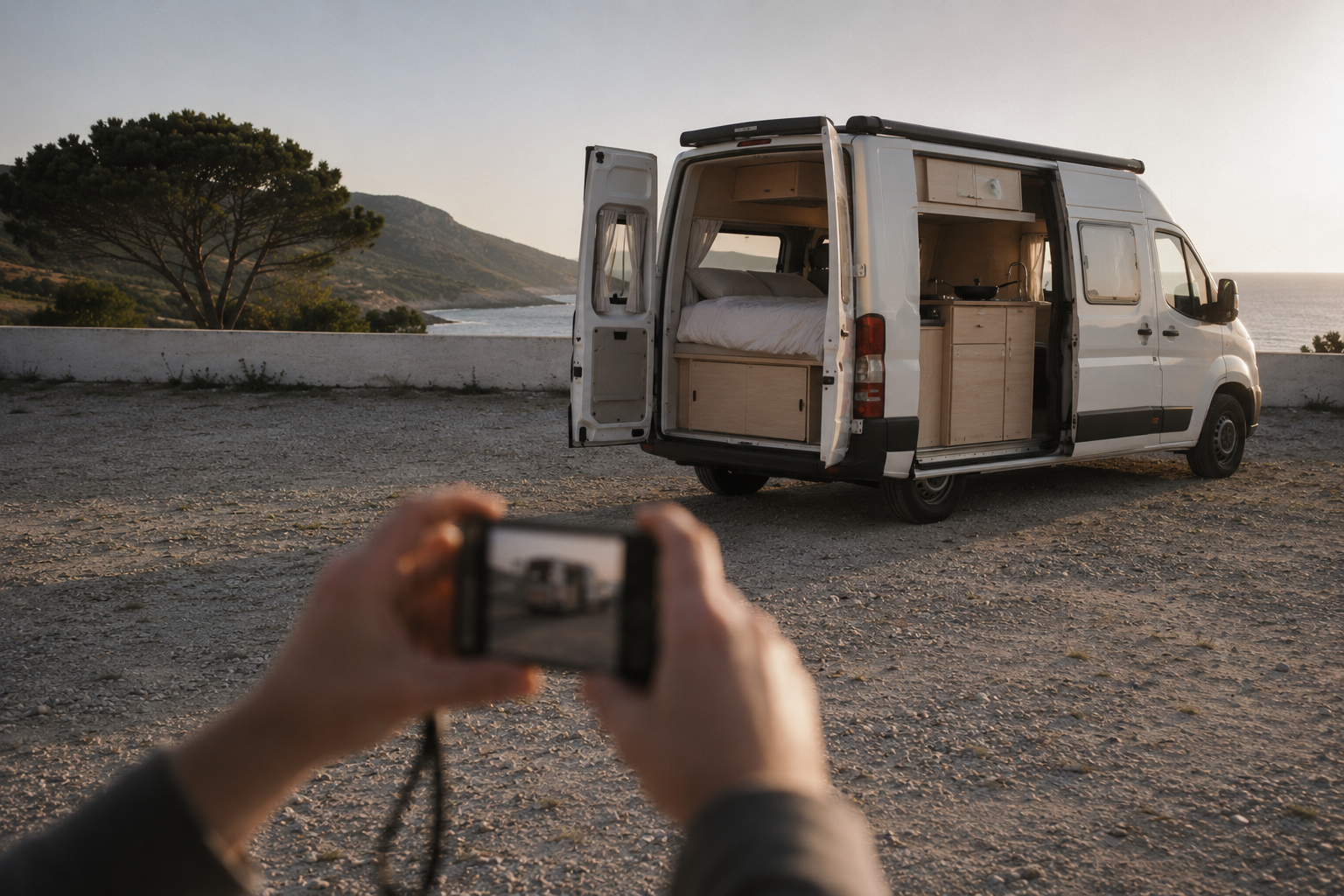
Not enough of the van. Six photos is a floor, not a target, and one of them has to be a floorplan or layout diagram, because the single question every campervan renter is silently asking is where everybody sleeps. Interiors shot in daylight with the curtains open, the bed made up, the kitchen in use, the storage open, and one shot with a person in frame for scale. If you have a walkthrough video, put it on the page. It answers more questions than any amount of copy.
No price, or a price that means nothing. "From €95 per night" is not a price to someone booking nine nights in August with two drivers and a dog. If they cannot arrive at a total, they cannot decide, and they will go and get a total somewhere else. This is the single most consequential thing on the page.
No availability. A page that describes a van but cannot say whether it is free on their dates is asking the visitor to do work on your behalf. Most will not.
Nothing that says you are a real business. Reviews, a named human, a phone number, a physical pickup address, photographs of the actual vehicle rather than a manufacturer render. Vehicle rental carries a trust deficit that you inherit whether you deserve it or not. Consumer authorities have spent years chasing the sector over pricing practices, and the UK's competition regulator has taken enforcement action over hidden car hire charges, with complaints about issues including hidden fuel charges and high insurance excess rising sharply in the period concerned. Your visitor has read those stories, or lived one.
When the only option is "enquire"
This deserves its own section because it is the most common structural problem in independent campervan rental, and operators rarely see it as a problem at all.
If your site offers a contact form instead of a booking, you have not built a booking funnel. You have built a lead funnel, and you are now in a race with every other operator that person messaged. They messaged three. Whoever answers first with a clear total price usually wins, and if your reply lands the following morning the van has often gone.
There is a second cost that is easier to miss. An enquiry form asks the customer to accept uncertainty at the exact moment they were ready to commit. They wanted to know if the van was free and what it costs. You gave them a wait. Every hour of that wait is an hour they spend looking at somebody else's site.
There are legitimate reasons to screen bookings, particularly around driver age, licence history and group type, and "request to book" is a reasonable model if the request is answered in minutes and the customer can see the price and the availability before they send it. What does not work is hiding both the price and the calendar behind a form and calling it personal service.
When they start and stop
If people are starting bookings and abandoning halfway, look at the form itself, because this is where the general research is most directly applicable.
Baymard's checkout research found that 39% of users abandoned a checkout because of extra charges appearing late, 19% because they were forced to create an account, and 18% because the process looked too long or complicated. Every one of those has a direct campervan equivalent.
Extra charges arriving late is the big one. In campervan rental the late surprises are cleaning fees, out-of-hours pickup charges, delivery, mileage packages, additional driver fees, gas, bedding, and excess reduction. If somebody sees €780 on the van page and €1,140 at the payment step, you have not just lost the booking. You have confirmed a suspicion they arrived with. Put everything in the total as early as the system allows, and if something genuinely cannot be calculated yet, say so in a sentence rather than letting it appear as a shock.
Forced account creation is pure loss. Nobody wants a login for a company they will use once a year. Let people book as a guest and offer the account afterwards, if at all.
Length and perceived length both matter. Ask for what you legally and operationally need at the point of booking, and gather the rest later. You need names, contact details, dates, vehicle, drivers and payment. You do not need passport numbers, full addresses for both drivers, employer details, emergency contacts and a dietary preference before the customer has paid a deposit. Anything you can collect during pre-arrival check-in should be collected then, not now.
When they reach payment and stop
This is the most expensive drop-off, because these people were ready.
The deposit is the usual suspect. A campervan deposit sits somewhere between a few hundred and a couple of thousand euros, and it is the biggest single number many customers will see in the whole process. If it appears for the first time on the payment screen, expect people to stop. If it appears on the van page with one sentence explaining what it covers, how it is held and when it is released, most people accept it without blinking. The number matters less than when they find out.
Card problems are more common than operators think. European payments require strong customer authentication, so a card that works fine in a shop can fail on a €600 pre-authorisation from an unfamiliar merchant, particularly for foreign cards, prepaid cards, or a bank that decides a campervan deposit looks like fraud. If your payment step offers exactly one method and no fallback, you are losing bookings you never hear about. Check your processor's declined transactions. That report is usually the most under-read page in the whole business.
Cancellation anxiety stops people who can afford it. Somebody booking four months ahead is committing to a trip that depends on jobs, health, school terms and a partner's schedule. If your cancellation terms are absent or buried, the safe choice is to close the tab and think about it. A clearly stated policy converts better than a generous one that nobody can find.
The hesitations that are specific to campervans
Generic checkout advice stops being useful here, because a campervan booking carries questions a hotel room does not.
Insurance and excess is the biggest. Your customer is not comparing policies. They are trying to work out what happens if they clip a wall in a village street built for donkeys. Give the excess figure, say whether a reduction is available and what it costs per day, and list what is not covered, since roof, tyres, windows, undercarriage and water ingress are the usual exclusions. Silence on this reads as a trap.
Mileage is next. An unexplained daily kilometre allowance forces the customer to plan their route before they are willing to book, which is not a thing people can do at that stage. Either include enough kilometres that nobody has to think about it, or make the overage rate obvious.
Then pickup and drop-off. Where exactly, at what times, what happens if a flight lands at eleven at night, is there parking for their car, how long does handover take. A vague location is a real objection, because a traveller without a car needs to know how they get to you before they can commit.
And the eligibility questions that quietly disqualify people at the last moment: minimum driver age, how long the licence must have been held, whether a second driver costs extra, whether the van can leave the country, whether pets are allowed. Every one of those should be visible before payment, because discovering them at the end does not just lose the booking, it wastes the customer's time and earns you a bad review from someone who never rented from you.
Speed and mobile are not a side issue
Plenty of campervan traffic arrives on a phone in the evening, and a slow booking flow on a phone is where good demand goes to die.
Google and Deloitte's study of 37 brands found that a 0.1 second improvement in mobile site speed was associated with a 10.1% increase in travel conversions. That is a tenth of a second. Whatever your image-heavy van pages are doing to load times is not cosmetic.
Then use your own booking flow on your own phone, on mobile data, from a cold start, as a stranger would. Not the admin view. The customer view. Count the taps, watch for the calendar that will not scroll, the date picker that resets, the form that loses everything when you switch apps to find your licence number, the payment step that renders off-screen. Most operators discover at least one hard blocker within five minutes of doing this, and many have never done it.
Not everything you lose was ever yours
This is the part most conversion advice skips, and it matters, because chasing unfixable abandonment is a good way to waste a winter.
Some people leave because your dates were not available, and no design change creates a van you do not have. Some leave because the price is above their budget, which is a positioning question rather than a UX one. Some are four months from booking and are simply gathering options. Some found a competitor closer to the airport. And some arrived on the wrong traffic entirely, having searched for campervans for sale, campervan conversions or campsite pitches.
That last one is worth checking before anything else. If your traffic is up and your bookings are flat, look at what those visitors actually searched for. Ranking for the wrong query produces exactly the symptoms of a broken booking flow while being a completely different problem.
The useful distinction: fix the friction that stops buyable demand, and stop treating unbuyable traffic as a failure of your website.
Follow up on the ones who nearly booked
Abandonment is not always final. SaleCycle's survey work found that 87% of travellers said they would consider returning to a booking they had abandoned, and travel bookings are researched over weeks, so a person who left on Tuesday may be entirely serious about the same van on Sunday.
That only works if you capture an email address early in the flow and actually use it. One message a few hours later, with the dates they were looking at, the total price and a link that takes them back to where they stopped. Not a discount. Not four emails. One useful reminder, because most of the time they got interrupted rather than put off.
If you use marketplaces alongside your own site, remember that this is the part of the relationship the platform keeps. Your own booking flow is the only place you get to follow up at all.
A diagnostic you can run this week
Give it an hour, in this order.
Pull the six numbers from the journey above for the last ninety days, split by device. Find the biggest single drop between two consecutive stages, because that is the only place worth working on right now.
Then book your own van. Use your phone, on mobile data, and go all the way to the payment screen with a real card. Write down every moment you had to guess, wait, or look something up. That list is your backlog, in order.
Then check three things you cannot see from the front end: your declined payments report, your response time to enquiries over the last month, and the actual search terms bringing people to the site.
If the drop is before booking starts, work on the van page, the total price and availability. If it is inside the flow, work on fields, guest checkout and mobile. If it is at payment, work on deposits, payment methods and cancellation clarity. One fix at a time, and measure the same six numbers again in a month.
When the booking system is the bottleneck
Sometimes the friction is not a design choice. It is the fact that the operator has no system capable of doing what the customer is asking for.
If availability lives in a spreadsheet, the website cannot show it. If prices change by season and length of stay, a static rate card will always be wrong somewhere. If contracts are PDFs and deposits are bank transfers, the booking cannot complete at eleven at night. In that situation the enquiry form is not a bad decision, it is the only decision available, and the fix is upstream of the website.
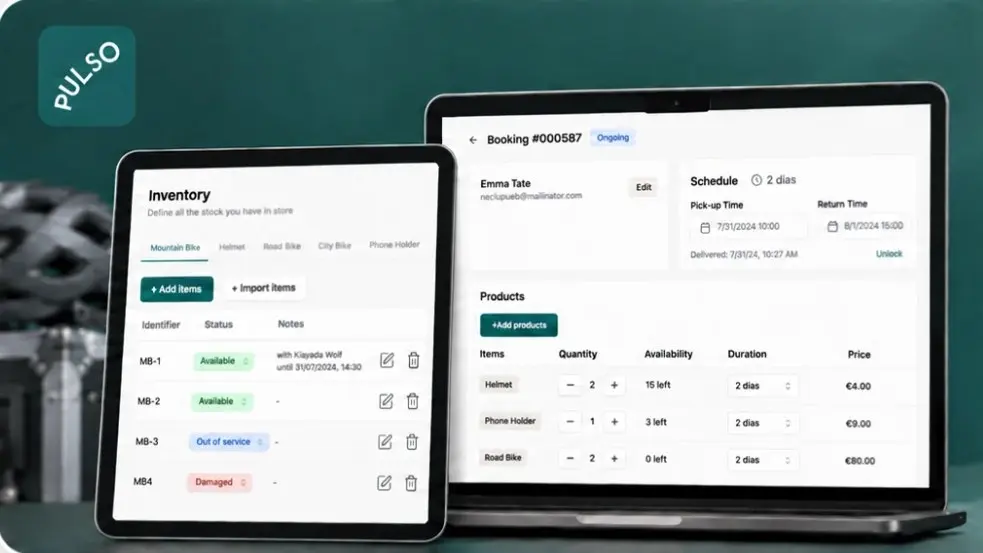
That is the gap Pulso is built for: live fleet availability, online bookings from your own site, digital rental contracts and Stripe payments taken at the point of booking. The specific tool matters less than the outcome, which is that somebody can find a van, see it is free, understand the full price, sign and pay, without waiting for you to wake up. If you want the mechanics, Pulso's guides on adding a booking engine to your website and keeping availability accurate in real time go into detail.
Getting traffic was the last problem. This one is about whether the people you already convinced can actually give you their money.