 Anita Valentinova
This article is part of the Bicycle rental business management guide for Spain
1. What actually changes with two locations
The problems that appear when running two locations without a centralised system are predictable. Bookings that arrive at the wrong location and need redirecting. Inventory that doesn't reconcile at the end of the day because someone moved bikes between sites without logging it. An owner making availability decisions without knowing the real state of each location.
None of that requires poor management to happen. It just requires volume to exceed the capacity of manual coordination. During peak season, that threshold arrives faster than expected.
2. Inventory: shared or independent per location
This decision shapes most of the operation with multiple locations, and it's better made before opening the second site than after.
With independent inventory per location, each premises has its own assigned fleet and bikes don't move between sites. Simpler to manage and no inter-location movements to track. The drawback is inflexibility: if one location has a waiting list and another has availability, you can't take advantage of that without physically moving bikes.
With shared inventory, bikes can be assigned to any location based on demand. More efficient in fleet use, but requires a system that knows where each unit is at all times. Without that system, shared inventory creates more confusion than independent.
For most businesses with two or three locations in the same area, a mixed model is most practical: a base fleet assigned to each location, with the ability to move units when demand justifies it, always with the movement logged in the system.
3. Bookings: routing to the right location
A booking that arrives at the wrong location is a problem regardless of availability. The customer who booked at the town centre and shows up at the harbour isn't a fleet problem — it's a system problem.
The online booking process needs to show available locations, let the customer choose where they want to pick up, and generate confirmation with the correct location's details. If the system doesn't do that automatically, there's manual work added to every booking.
Returns at a different location from pickup are convenient for customers in destinations where the geography makes sense. But they carry an operational cost: someone has to log the bike's arrival at the new location, and at end of day there's redistribution needed so each site has the fleet it needs for the following day. Before activating that option, decide whether it carries an extra charge and who manages the redistribution.
4. Visibility for the owner
With one location, the owner has direct visibility. With two, they need real-time data from a single dashboard: occupancy per location, which bikes are rented at each site and when they're due back, revenue per location, and alerts when something falls outside the normal protocol (overdue return, unresolved maintenance).
A system that requires accessing two separate panels, one per location, doesn't solve the coordination problem. It just moves it.
Staff at each location also need system access to see their location's bookings and fleet status. Without that, they depend on calls or messages to know whether there's availability, which adds friction at exactly the moments when load is highest.
5. Differentiated pricing per location
A premises on the seafront with high tourist demand can sustain higher prices than one in a quieter part of the same destination. The management system needs to allow setting different rates per location without the customer having to understand the internal structure.
The customer selects their location, sees the price for that location, and books. Without you managing two parallel systems or making manual adjustments for each booking.
6. End-of-day inventory reconciliation
With one location, the daily reconciliation is a 10-15 minute routine: how many bikes went out, how many came back, which are in maintenance, which have pending returns.
With two locations and no centralised system, that process doubles and discrepancies between sites are harder to catch. A bike marked as available in the system but physically sitting at the other location doesn't appear as an error until someone tries to assign it.
A good management system gives you the end-of-day summary for each location without building it manually. You see which units are active, which have returns scheduled for tomorrow, and which will be available at each site.
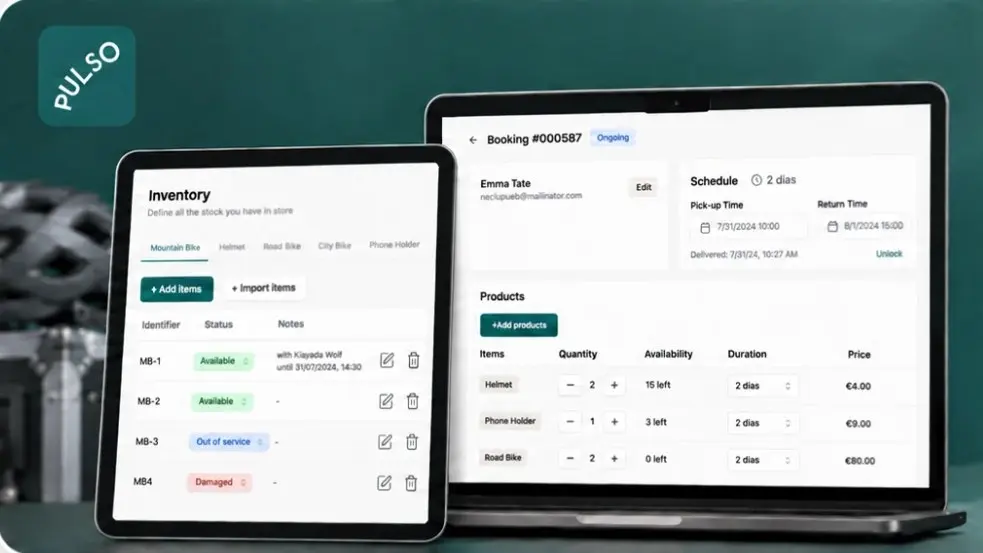
PULSO manages multiple locations from a single dashboard. Inventory, bookings, revenue and fleet status for each location are centralised with independent visibility per site.
See what PULSO includes or get started free.
Frequently asked questions
When does it make sense to open a second location?
When the first location can't serve existing demand, not to create new demand. A second location amplifies what's already working. If the first runs at high occupancy consistently and you're turning customers away, the second makes sense. If the first isn't filling up, a second location won't fix that.
Can one employee manage two locations?
In low season with low volume and nearby sites, a rotation may work. In peak season with volume at each location, you need dedicated staff at each site. Trying to cover both with one person generates service errors and tracking errors.
How do I handle bikes that a customer picks up at one location and returns at another?
Decide first whether the option is available, whether it carries an extra charge, and who manages end-of-day redistribution. Without those three things clear, cross-location returns create more work than they save.
Is it better to open a second location outright or reach an agreement with another operator?
An owned location gives more control and margin, but more upfront investment and management load. An agreement with a local operator (you supply bikes, they run the location, they pay you a fee or commission) reduces investment and risk but also control. Both can make sense depending on available capital and where the business is.