 Ivan Stoilov
Last updated: 19th May 2026
Before buying a single bike, it's worth sitting down to define the model. Not as a formality, but because the decisions you make in the first few months are hard to undo: the type of customer you decide to serve, the area where you set up, the initial size of the fleet. All of that shapes everything that follows.
This article is part of the Bicycle rental business management guide.
1. Analyse the market before deciding anything
The first step isn't choosing bikes or finding a premises. It's understanding whether there's real demand in the area you're interested in and what that demand looks like.
The zones with most potential for a bicycle rental business are tourist destinations with seasonal footfall (coast, mountains, heritage cities), cities with established cycling infrastructure (bike lanes, parking, public transport connections), and natural environments with marked routes where visitors already arrive intending to do outdoor activities.
What you need to study before choosing a location: how much competition already exists, what they offer and at what price, and what gap they're not covering. A business in a saturated area of generic rentals can work if it specialises (electric only, guided routes only, families only). One in an area without competition can fail if the demand simply isn't there.
Talk to local hotels and tourist apartments before opening. They know better than anyone what their guests ask for and what they can't find.
2. Define your business model
There are several ways to structure a bicycle rental business and not all of them have the same investment profile or margin.
Hourly, daily or weekly rental is the most common model. Flexible rates by duration, aimed at passing tourists or occasional locals. It's the easiest to operate but also the most price-competitive.
Rental with guided routes adds value to the experience and supports higher prices. A food route, a cultural route, a natural landscape route. The customer pays for the experience, not just the bike. It requires more resources (a guide, specific insurance, route preparation) but differentiates the business.
Electric bikes attract a different customer profile: higher spending, less interest in physical effort, willing to pay more. Demand has grown steadily in recent years in coastal and urban destinations. Higher upfront cost but also higher margin per rental.
B2B services to hotels, campsites, tourist apartments or local businesses. The hotel integrates the rental as a service for their guests, you manage the fleet. Lower margin per unit but more predictable volume and no direct acquisition cost.
Many businesses combine models. Individual rental funds the daily operation; guided routes and B2B add revenue with less management overhead in peak season.
A rough pricing reference for individual rental: 1 hour €5–€10, half day €12–€20, full day €18–€35, full week €70–€120. These vary considerably by location and bike type.
3. Choose your location carefully
Location matters more than the fleet. A well-placed premises with average bikes will outperform a poorly placed one with excellent bikes.
For tourism, the criterion is visibility and access from high-footfall points: harbour, beach, train or bus station, historic centre. For day-trippers and cycle tourists, proximity to known routes or natural spaces. For residents, population density and connection to cycling paths.
Partnerships with nearby hotels, hostels or campsites work well for volume without marketing investment. If a hotel recommends your business to its guests, you capture customers who are already in the area and already intend to be active. A clear referral fee paid promptly keeps that relationship working.
If the premises has a high rental cost, verify that your estimated booking volume justifies it before signing. A prime seafront location can make sense in July and August and become a liability in November.
4. What fleet you need and what type
The most common mistake at launch is buying too much fleet. An underused fleet in low season is tied-up capital that generates nothing.
A reasonable starting point: between 10 and 20 units for a first business, with room to scale based on real demand from the first year. It's better to have occasional waiting lists in peak season than 30 bikes sitting idle in October.
Urban bikes are lightweight, easy to handle and low-maintenance, ideal for city or coastal riding. Mountain bikes (MTB) make sense in areas with off-road routes or elevation change. Electric bikes have growing demand and higher margin but higher upfront cost and more maintenance complexity. Children's bikes and child seats are an add-on many families look for and few operators have properly sorted.
Beyond the bikes you'll also need: locks (at least one per unit), helmets if you offer them, basic maintenance tools (spanners, puncture repair kit, pump), and premises signage.
5. Permits, licences and insurance
To operate in Spain you need to register as self-employed (autónomo) or form a company, register with Hacienda under IAE code 751.1 (bicycle rental), and obtain the municipal opening licence for your type of premises.
There's no legal obligation for specific insurance for bicycle rental, unlike motor vehicle hire. But operating with no coverage is a real risk. A voluntary fleet insurance policy covers theft and accidental damage, which are the two most frequent scenarios. Some councils or regional governments require general civil liability insurance as part of the activity licence, so check before opening.
If you offer paid guided routes, check whether your region requires a tourism guide qualification for that activity.
6. Initial investment: what to expect
The three main spending blocks are fleet, premises and management tools.
A rough guide for a small business with 15 conventional bikes: fleet (15 mid-range bikes) €4,500–€9,000; add electric bikes and the cost rises significantly (€1,200–€2,500 per electric unit). Premises (deposit plus first months): €1,500–€6,000 depending on location. Auxiliary equipment (locks, helmets, tools, signage): €1,000–€2,500. Management software: from €29/month. Licences and admin: €500–€1,500.
Rough total to start with a proper buffer: between €10,000 and €25,000. Working capital for the first months of fixed costs (rent, insurance, self-employment contributions) is the most underestimated item. Plan for at least a 3-month cushion before counting on regular income.
Return can be fast in tourist areas with a marked peak season. Many operators recover the initial investment in the first or second season if the location is good and booking volume is sufficient.
7. Maintenance: what doesn't appear in the initial budget
A fleet that isn't maintained creates problems at the worst moment: a customer mid-route with a broken chain, brakes that don't respond, a flat tyre before check-in.
Maintenance for a rental fleet under intensive peak-season use includes: brake and chain checks every certain number of uses, daily tyre pressure checks, regular cleaning, and a full service on each unit at the start and end of each season.
For a 15-20 bike fleet, the first-year maintenance cost in parts and repairs can be between €1,500 and €3,000. Having basic tools and knowing how to handle the most common repairs (punctures, brake adjustment, chain lubrication) reduces that cost and avoids waiting times when something breaks during the day.
Mark units as "in maintenance" in your management system so they can't be assigned to bookings while they're out of service.
8. Digitalise the business from day one
The temptation is to start with Excel and paper and see how it goes. The problem is that when volume grows, migrating from a spreadsheet to a real system with bookings, contracts and accumulated data is more work than it looks.
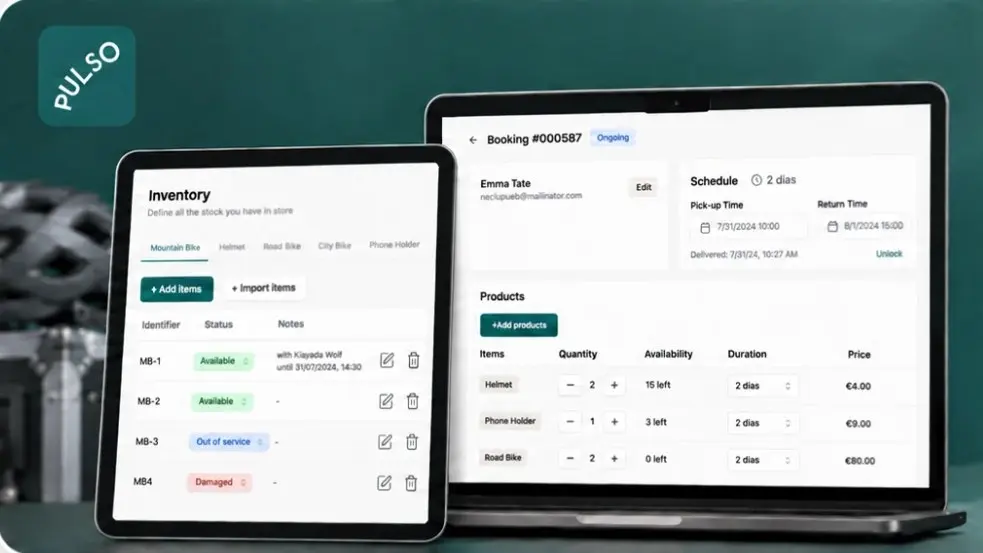
Rental management software like PULSO lets you manage bookings, inventory, digital contracts and payments from day one. What changes in the daily operation is concrete:
The customer books online at any hour without you needing to be present. They receive the contract on their phone and sign it before arriving. Check-in takes under 2 minutes. Payment happens via QR or payment link, no physical card reader needed. Inventory updates automatically when a booking is confirmed or cancelled. Every invoice is automatically recorded for Verifactu compliance.
PULSO starts at €29/month on the Starter plan. Includes unlimited fleet, Verifactu included, no transaction commissions, no lock-in. When you register you can book a free onboarding session: a real person sets everything up with you in 20 minutes.
9. Marketing: how to get the first customers
A new business in a tourist area with a good location generates its first customers almost on its own, through visibility. But depending only on foot traffic doesn't scale.
Google Business Profile is the first and most important step. A complete and up-to-date profile (real photos, opening hours, description, booking link) is what determines whether you appear when someone searches "bicycle rental [your city]" on Google Maps. Get reviews from your first satisfied customers from the start. 20-30 positive reviews have a visible impact on local rankings.
Direct online bookings from your own website reduce dependence on commission-paying platforms. Aggregators like TravelandRent can generate initial traffic and are useful for gaining visibility early on. For an established business, the goal is to gradually reduce that dependence and grow the direct channel.
Local partnerships with hotels, tourist apartments and travel agencies are the most efficient route to volume without acquisition cost. A clear referral fee paid promptly keeps the relationship going.
Visual content on social media works well for this type of business. Photos and videos of customers using the bikes, local routes, the surroundings. It doesn't require elaborate production, just consistency and authenticity.
10. Calculate your return before opening
Before signing the premises lease and buying the fleet, run the numbers for your specific area.
The variables that determine profitability are: average price per rental, average number of daily rentals in peak and low season, number of months of meaningful activity per year, and monthly fixed costs (premises, insurance, software, self-employment contributions).
A rough indicative example for a 15-bike fleet in a coastal area with a 4-month peak season: average price €20/day, average peak occupancy 70% (10-11 bikes rented per day), daily revenue €200-€220, monthly peak revenue €6,000-€6,600, annual revenue including low season at 30% occupancy: approximately €28,000-€32,000.
Approximate annual fixed costs: premises €12,000, insurance €1,500, software €350, self-employment contributions €4,000, maintenance €2,000. Total fixed: ~€20,000.
Rough gross margin before tax in year one: €8,000-€12,000, assuming fleet investment is already amortised or financed. In year two, without the initial investment, the margin improves significantly.
These numbers are illustrative. Your location, model and operational efficiency will change them. But doing this exercise before opening avoids the October surprise of insufficient income to cover winter fixed costs.
Frequently asked questions
Is it better to buy the fleet outright or finance it?
For a first small fleet (10-15 conventional units), buying usually makes more sense. It avoids financing costs and gives more control. If you want to include electric bikes from the start and initial capital is limited, financing can be a reasonable option for that segment.
When does the business become profitable?
In tourist destinations with a clear peak season, many operators recover the initial investment in the first or second season if the location is good. In areas with more distributed demand, the timeline is longer but the operation is more stable year-round.
Can I start with second-hand bikes?
Yes, but selectively. Good-condition second-hand bikes reduce upfront investment. The risk is that a poorly selected second-hand fleet generates higher maintenance costs and more customer incidents. If you go that route, have each unit properly checked before putting it into service.
 Ignasi Castillo