 Anita Valentinova
This article is part of the Bicycle rental business management guide.
1. What's actually different about managing an electric bike
With a conventional bike, if something's not quite right (slightly low tyre, brake needs adjustment), most rentals still work out fine. With an electric, the margin for error is narrower.
A bike that goes out at 15% battery for a half-day rental won't make it back under its own power. That produces a stranded customer mid-route, a call to your team, an assistance cost, and a reputational problem — all of which a basic pre-rental charging check prevents.
The value per unit also raises the stakes for inventory control. A mid-range conventional bike is worth €300–€600. An equivalent electric is worth €1,200–€2,500. Not knowing exactly where each electric unit is at the end of the day means managing assets of that value without visibility.
Maintenance has additional components a conventional bike doesn't have: motor, battery, electronic controller, display, wiring. Each with its own service interval.
2. Battery protocol before each rental
The charge level of each unit needs to be logged before it goes out. Not estimated — checked. If a unit has less than 80% for a full-day rental, it charges first.
This requires charge time to be built into availability planning. An electric bike returning from a full-day rental needs 3-5 hours to be ready again. If you have 10 electric bikes and they all come back at 6pm, there's no way to have them ready for the next morning without an organised charging plan the night before.
At handover, tell the customer the estimated range for their route. If they're planning 40 km and the battery gives 60 km at moderate pedalling, say so. That prevents mid-route phone calls.
3. Inventory control at higher value
With conventional bikes, imprecise tracking is an operational inconvenience. With electric bikes, the same imprecision has more financial weight.
The management system needs to tell you at any moment which specific electric unit each customer has. Not "an electric bike is out" — which serial number is with which customer, since what time, and when it's due back.
If you have multiple models with different ranges, the system needs to differentiate that too. Assigning a 50 km-range bike to a customer planning a 45 km route is a risk. An 80 km-range bike isn't.
4. Specific maintenance
Electric bikes have components that degrade with use in ways conventional bikes don't.
A lithium battery handles between 500 and 1,000 full charge cycles before degradation becomes noticeable. A battery that starts delivering less range than specified doesn't usually fail suddenly — it gradually declines until the problem becomes obvious to a customer. Checking it before that happens is cheaper than managing it afterwards.
Motor and controller service follows manufacturer guidelines, typically every 2,000–3,000 km. Brakes wear faster than on a conventional bike due to the additional weight. The display may need firmware updates if the manufacturer releases them.
Keep a separate record per unit in your management system: last battery service date, approximate charge cycles, next scheduled service date, and intervention history.
5. What to charge for an electric bike
50%–100% above an equivalent conventional bike is the standard range and what customers accept. The experience is genuinely different: no effort on climbs, more distance covered, accessible to people who aren't physically fit.
Some indicative references: 1 hour €8–€15, half day €20–€35, full day €35–€60, week €120–€200. These vary by location and fleet quality.
If you have a mixed fleet, the booking process needs to clearly show the price difference between types and let the customer choose. Many customers specifically want an electric bike and will pay more for it, but if the system doesn't make it visible they may end up booking conventional without realising.
6. Fleet insurance for electric bikes
The replacement cost of an electric bike makes it worth checking the policy more carefully than for conventional bikes.
Before taking out coverage for electric bikes, verify: whether the policy covers the motor and battery in addition to the frame, what the insured value is (it should reflect current replacement price, not the purchase price from three years ago), whether it covers theft during the rental when the bike is away from your premises, and whether there are conditions about lock type or permitted parking during the rental.
Some generic fleet policies exclude electrical components or cover them below their actual value. Worth checking before a claim makes it obvious.
7. Managing mixed fleets with software
If you have conventional and electric bikes in the same fleet, the management system needs to separate them at every level: independent availability by type, separate pricing by type and duration, and a contract with specific electric bike information (estimated range, usage instructions, what happens if the battery runs out during the rental).
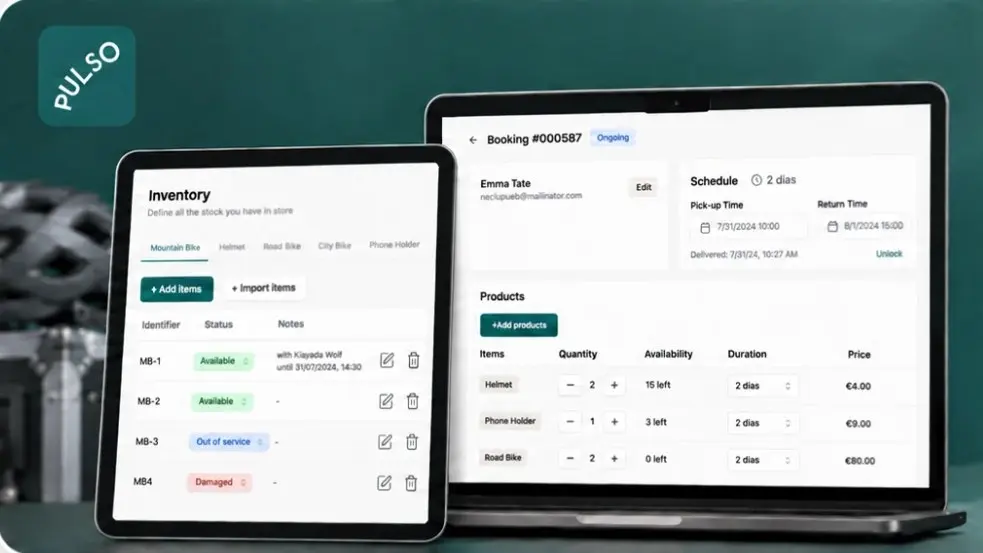
PULSO lets you set up different types of equipment within the same system. Conventional and electric bikes have their own availability and rates without making the booking process more complicated for the customer.
See what PULSO includes or get started free for 14 days.
Frequently asked questions
How many electric bikes makes sense in a fleet?
A reasonable starting point is 20%–40% of your total fleet. With 3-5 units you can measure real demand in your area before investing further.
What if a customer returns the bike with a flat battery?
It needs to be in the contract. The standard practice is that the customer returns the bike with approximately the same charge level they received. If it comes back completely flat, you can charge a recharge fee (€5–€10 is common). Without it in writing, applying it is difficult.
Is maintenance significantly more expensive for electric bikes?
30%–50% more per unit per year is a reasonable reference. That needs to go into the profitability calculation per unit before deciding how many to add to the fleet.
Can I add electric bikes to the fleet without prior experience?
Yes, with preparation. Before adding them, get familiar with the specific model: how to charge, how to spot battery problems, what to do if the motor fails. The supplier usually offers basic training.